
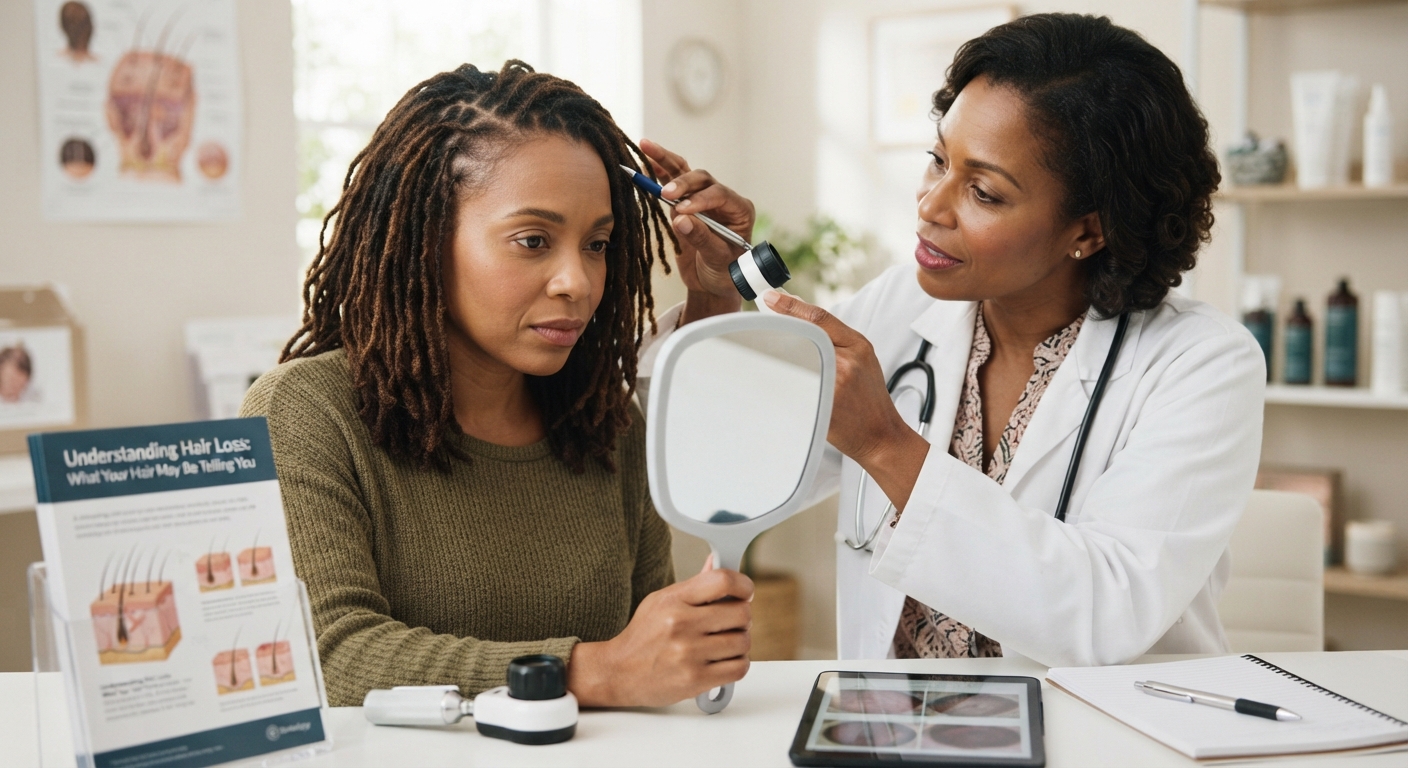
Understanding Hair Loss: What Your Hair May Be Telling You
If you’re experiencing hair loss, you may have found yourself asking, “Why is this happening to me?”
Maybe you’ve noticed more hair in your brush, your shower drain, or on your pillow. Maybe your hair feels thinner than it used to, or you’re noticing changes in your scalp that you’ve never experienced before.
And sometimes, you may not even know where to start.
I want you to know that you don’t have to suffer in silence.
Hair loss can be frustrating, emotional, and sometimes confusing. But understanding what may be happening is an important first step in creating a better hair and scalp journey.
Hair Loss Isn’t Always Just About Your Hair
One of the biggest things I want my clients to understand is that your hair and scalp can sometimes give us clues about what is happening within the body.
There are many possible factors that can contribute to hair loss or changes in the scalp. These can include genetics, hormonal changes, stress, nutrition, certain medications, underlying health conditions, and even the way we care for and style our hair.
That’s why I believe it’s important to look at the bigger picture.
Instead of simply asking, “What product should I use for my hair?” we can start asking:
What could be contributing to this change?
Different Types of Hair Loss
Not all hair loss looks the same.
Some people experience gradual thinning throughout the scalp. Others may notice specific areas where the hair is becoming thinner or no longer growing as it once did. Some may experience increased shedding after a stressful event or significant change in their body.
Here are the most common types of hair loss I have seen in my salon:
Androgenetic alopecia – often associated with genetics and hormonal influences.
Alopecia areata – an autoimmune condition that can cause sudden, patchy hair loss.
Telogen effluvium – increased shedding that can occur after certain physical or emotional stressors.
Traction alopecia – hair loss that can result from repeated tension or pulling on the hair.
The important thing to remember is that the cause matters.
Understanding what may be contributing to your hair loss can help guide the next steps instead of simply treating the symptom.
Let’s Talk About Your Scalp, Too
Your scalp is the foundation for your hair.
If you’re experiencing dryness, irritation, excessive oiliness, flaking, tenderness, or other changes, those are things worth paying attention to.
Your scalp deserves just as much care and attention as the hair growing from it.
This is why I take the time to understand what my clients are experiencing instead of taking a one-size-fits-all approach.
Your hair journey is personal, and your care should be personal, too.
Looking Beyond the Surface
Sometimes, we need to get down into the nitty-gritty of what’s going on.
For clients experiencing hair loss or certain scalp concerns, Hair Mineral Analysis Testing can provide additional information about mineral levels and certain patterns that may be worth discussing with an appropriate healthcare professional. We offer HaiIDetect testing in the salon, this test provides a 90 day view of what contributes to your hair growth.
It’s not about looking at one test and saying, “This is the answer.”
Instead, testing can be one piece of the puzzle as we gather more information about your individual situation.
When we have more information, we can have a better conversation about what your hair and scalp may need and whether additional professional evaluation may be appropriate.
You Don’t Have to Figure It Out Alone
I know that hair loss can affect more than just your appearance.
It can affect your confidence. It can affect how you feel when you look in the mirror. And for some people, it can be something they don’t feel comfortable talking about with anyone.
That’s why creating a safe space for my clients is so important to me.
I want you to feel comfortable sharing what you’ve been experiencing—whether it’s been happening for weeks, months, or even years.
Your concerns deserve to be heard.
Your Hair Journey Is Personal
There is no single treatment or routine that works exactly the same way for everyone.
Your history, your scalp, your lifestyle, your hair practices, and the factors contributing to your concerns are all part of your individual story.
So if you’re experiencing hair loss, don't immediately blame yourself or assume that you just need another hair product.
Start with understanding.
Pay attention to the changes you’re seeing. Ask questions. Get the appropriate professional evaluation when needed. And give yourself permission to seek help.
Because when we understand more about what’s happening, we can make more informed decisions about the next steps in your hair and scalp journey.
You don’t have to suffer in silence. There is a safe space for you here, and I’m here to help you better understand your hair and scalp.
FIND OUT WHAT’S HAPPENING IN THE BODY BY TAKING THE HairIDetect Test!
Understanding Hair Loss: What Your Hair May Be Telling You
If you’re experiencing hair loss, you may have found yourself asking, “Why is this happening to me?”
Maybe you’ve noticed more hair in your brush, your shower drain, or on your pillow. Maybe your hair feels thinner than it used to, or you’re noticing changes in your scalp that you’ve never experienced before.
And sometimes, you may not even know where to start.
I want you to know that you don’t have to suffer in silence.
Hair loss can be frustrating, emotional, and sometimes confusing. But understanding what may be happening is an important first step in creating a better hair and scalp journey.
Hair Loss Isn’t Always Just About Your Hair
One of the biggest things I want my clients to understand is that your hair and scalp can sometimes give us clues about what is happening within the body.
There are many possible factors that can contribute to hair loss or changes in the scalp. These can include genetics, hormonal changes, stress, nutrition, certain medications, underlying health conditions, and even the way we care for and style our hair.
That’s why I believe it’s important to look at the bigger picture.
Instead of simply asking, “What product should I use for my hair?” we can start asking:
What could be contributing to this change?
Different Types of Hair Loss
Not all hair loss looks the same.
Some people experience gradual thinning throughout the scalp. Others may notice specific areas where the hair is becoming thinner or no longer growing as it once did. Some may experience increased shedding after a stressful event or significant change in their body.
Here are the most common types of hair loss I have seen in my salon:
Androgenetic alopecia – often associated with genetics and hormonal influences.
Alopecia areata – an autoimmune condition that can cause sudden, patchy hair loss.
Telogen effluvium – increased shedding that can occur after certain physical or emotional stressors.
Traction alopecia – hair loss that can result from repeated tension or pulling on the hair.
The important thing to remember is that the cause matters.
Understanding what may be contributing to your hair loss can help guide the next steps instead of simply treating the symptom.
Let’s Talk About Your Scalp, Too
Your scalp is the foundation for your hair.
If you’re experiencing dryness, irritation, excessive oiliness, flaking, tenderness, or other changes, those are things worth paying attention to.
Your scalp deserves just as much care and attention as the hair growing from it.
This is why I take the time to understand what my clients are experiencing instead of taking a one-size-fits-all approach.
Your hair journey is personal, and your care should be personal, too.
Looking Beyond the Surface
Sometimes, we need to get down into the nitty-gritty of what’s going on.
For clients experiencing hair loss or certain scalp concerns, Hair Mineral Analysis Testing can provide additional information about mineral levels and certain patterns that may be worth discussing with an appropriate healthcare professional. We offer HaiIDetect testing in the salon, this test provides a 90 day view of what contributes to your hair growth.
It’s not about looking at one test and saying, “This is the answer.”
Instead, testing can be one piece of the puzzle as we gather more information about your individual situation.
When we have more information, we can have a better conversation about what your hair and scalp may need and whether additional professional evaluation may be appropriate.
You Don’t Have to Figure It Out Alone
I know that hair loss can affect more than just your appearance.
It can affect your confidence. It can affect how you feel when you look in the mirror. And for some people, it can be something they don’t feel comfortable talking about with anyone.
That’s why creating a safe space for my clients is so important to me.
I want you to feel comfortable sharing what you’ve been experiencing—whether it’s been happening for weeks, months, or even years.
Your concerns deserve to be heard.
Your Hair Journey Is Personal
There is no single treatment or routine that works exactly the same way for everyone.
Your history, your scalp, your lifestyle, your hair practices, and the factors contributing to your concerns are all part of your individual story.
So if you’re experiencing hair loss, don't immediately blame yourself or assume that you just need another hair product.
Start with understanding.
Pay attention to the changes you’re seeing. Ask questions. Get the appropriate professional evaluation when needed. And give yourself permission to seek help.
Because when we understand more about what’s happening, we can make more informed decisions about the next steps in your hair and scalp journey.
You don’t have to suffer in silence. There is a safe space for you here, and I’m here to help you better understand your hair and scalp.
FIND OUT WHAT’S HAPPENING IN THE BODY BY TAKING THE HairIDetect Test!
Disclaimer: This educational content is for informational purposes only and is not intended to diagnose, treat, cure, or prevent any disease or medical condition. Hair loss can have many possible causes. If you are experiencing sudden, severe, or unexplained hair loss or scalp symptoms, please consult a qualified healthcare professional for appropriate evaluation and care.
Disclaimer: This educational content is for informational purposes only and is not intended to diagnose, treat, cure, or prevent any disease or medical condition. Hair loss can have many possible causes. If you are experiencing sudden, severe, or unexplained hair loss or scalp symptoms, please consult a qualified healthcare professional for appropriate evaluation and care.
Ready To Start Your
Hair Wellness Journey?
Take the first step toward understanding your hair and scalp health
with a personalized consultation.
Ready To Start Your
Hair Wellness Journey?
Take the first step toward understanding
your hair and scalp health
with a personalized consultation.
Privacy Policy · Terms & Conditions
© 2026 Krown Wellness. All Rights Reserved.
Privacy Policy · Terms & Conditions
© 2026 Krown Wellness. All Rights Reserved.